헤이그에서 오랫동안 알고 지낸 친한 친구인 Ludmila Rodrigues와 Mike Rijnierse가 지난 6월 초 아주 반가운 전화를 해왔다. Zeeland, 내가 그때까지 한 번도 가보지 못했던 곳에 있는 아주 오래되고 흥미로운 교회에서 site-specific installation을 할 예정인데, 사운드를 맡아 달라는 것이었다. “아이고, 감사합니다!” 하고는 며칠 후 그들의 스튜디오에서 첫 미팅을 가졌다.
Veere라는 기차도 들어가지 않는 작은 마을에 자리한 Grotekerk(“큰 교회”라는 뜻으로, 네덜란드 도시마다 있는 대표 교회쯤으로 생각하면 된다)에서의 전시였다. Lud가 보여준 프린트물과 웹사이트 속 교회는 구조가 확 트여 있고 전시 공간으로도 운영되는 곳이었다. 실제로 박물관처럼 쓰이며 크고 작은 전시들이 열리고, 매년 Kerkmeester라는 프로젝트를 통해 예술가들이 커미션을 받아 전시를 하는데, 올해는 Lud와 Mike 차례였다. 그들이 말해 준 전시의 컨셉은 Underwater!
최근 예술계에는 환경과 인간 외 존재들에 관한 주제가 많다. 당대의 중요한 문제이기도 하고, 인간 중심의 사고에서 벗어나려는 흐름이기도 하다. 학생들도 종종 이런 주제를 다루니 낯설지는 않다. 그러나 내 흥미와는 거리가 있었던 이유는, 물속 환경을 이야기하려면 녹음을 해야 한다는 점 때문이었다. 나는 20년 가까이 전자음악에 몸담으며 단 한 번도 field recording을 해본 적이 없었다.
나는 왜 녹음에 흥미가 없었을까? 흥미로운 소리를 듣고 감동하거나 명상에 잠긴 적은 많지만, 그것을 작품으로 담는 방식은 내 작업 방향성과 달랐다. 다른 예술가들이 만든 field recording 기반의 작품을 듣는 것으로 충분하다고 생각해 왔다.
그런데 이번 프로젝트는 달랐다. “이제 안 해본 것을 해봐야 한다”는 강한 내적 목소리가 있었다. 이런 기회가 아니고서야 내가 뜨거운 햇볕이나 비바람 속에서 몇 시간을 마이크 들고 서 있을 리가 있겠는가.
실제로 최근 나는 다양한 변화를 시도했다. 2024–2025년에는 학교에서 Analog Studio 수업을 청강하며 완전히 새로운 방식으로 작품을 써 보기 시작했다. 물론 DIY 세계는 계속 확장 중이지만, 늦기 전에 새로운 것들을 경험해 보고 싶었다. 한 번으로 충분하다면 그걸로 족하지만, 그 과정이 내게 어떤 변화를 가져올지 모른다. 그래서 흔쾌히 “YES!”를 외치며 프로젝트에 돌입했다.
Grotekerk VeereSome notes after the visit
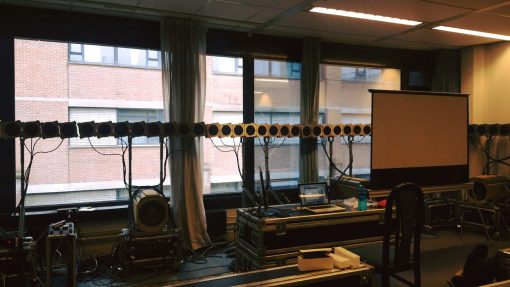
7월 초, 한국에 휴가 가기 전 나는 Lud와 Mike와 함께 Veere를 방문해 내 인생 첫 field recording을 했다. 교회 공간을 둘러보니 동기부여가 폭발했다. 가장 흥미로웠던 것은 천장이 아주 높다는 점이었다. 우리는 2층에도 스피커를 두었고, 10미터 높이에 8채널(4개의 스테레오 페어), 17미터에는 4개의 스피커를 천장을 향해 배치했다. 옥토포닉이라기보다는 확산(diffusion)에 가까운 구성이었다.
내 상상 속에서 청자들은 물속에 있고, 17미터 위의 스피커는 마치 지상을 상징하는 듯했다.
집에 돌아와서는 수도꼭지, 샤워 등으로 샘플을 만들었고, Open Data Archive에서 과학 목적으로 업로드된 underwater recording들을 다운받았다. 그런데 들으면서 깨달은 것은 우리가 상상하는 “물속 소리”는 사실 미디어가 주입한 이미지라는 점이었다. 실제 소리들은 전혀 다르게 들렸다. 자갈을 긁는 듯하거나 crackle noise generator 같은 노이즈와 어쿠스틱 사운드가 섞여 있었고, 가끔 마이크를 툭툭 치는 듯한 소리가 들어 있어 ‘아, 레코딩이구나’ 하고 느끼게 했다.
그래서 오히려 나는 억지로라도 ‘물’의 이미지를 덧입혀야겠다고 생각했다. 물속 소리와 물 밖의 소리가 함께 모였다.
또 다른 재료는 Analog Studio에서 녹음한 신호들이었다. 단순히 물속 소리를 재현하는 것만으로는 예술적 의미가 없다고 생각했다. 나는 오히려 듣는 이의 상상력을 열어주고 싶었다. 그래서 synthetic sound들을 더해, 미지의 세계를 미지로 남기고자 했다.
결국 5–10분짜리 작품을 15개나 만들었고, 여름 내내 한국에서 시원한 물소리를 들으며 헤드폰으로 작업했다.
12채널 spatialization은 WFSCollider로 마무리했다. 레이어마다 다른 출력과 믹싱을 적용했고, 일부는 WFSCollider 패턴을 이용해 spatial motion과 sound modification이 일체화되도록 했다. 예컨대 granular한 처리를 하면서 density가 커지면 위치 이동의 편차(deviation)도 커지는 식이었다.
Field Recording
한국에서 돌아온 바로 다음날, 짐을 풀자마자 다시 Veere로 향했다. 시차 적응은 힘들었지만 주로 저녁에만 고생했고, 낮 동안은 mastering을 마무리했다. 걱정했던 17미터의 시간차도, 두 레이어가 뚜렷할 때와 모호할 때가 적절히 섞여 흥미로운 효과를 냈다. 그리고 후반에 추가된 bass shaker 덕분에, 귀를 바닥에 대면 천장에서 들려오는 소리가 바닥으로 전이되는 듯한 오묘한 효과도 느낄 수 있었다. 볼륨이 낮아도 청중이 온몸으로 소리를 느낄 수 있었다.
@Benjamin van der Spek Mike, Rob, Lud and I from the top left.@Benjamin van der Spek
설치는 Lud, Mike이 함께 준비했다. 그 둘은 거대한 녹색 천에 핀과 줄을 설치하고 Rob이 만든 모터 인터랙션으로 파도를 만들어내는 장치(위의 이미지)였다. 단순해 보이지만 안정적인 대규모 움직임을 구현하기 위해 엄청난 노력이 필요했다. 셋다 정말 대단하다. (크레인 타고 17미터까지 올라가는 그런 작업은 나는 절대 못한다!)
음악은 약 두 시간 지속된다. 전시는 10월 26일까지 이어지고, 내년 봄 재오픈 예정이다. 많이 들 가서 보시길!
In early June, my longtime friends in The Hague, Ludmila Rodrigues and Mike Rijnierse, gave me a surprising call. They had received a commission for a site-specific installation in Zeeland—at an old and fascinating church I had never been to before—and asked me to take care of the sound. “Absolutely! Thank you!” I replied, and a few days later we had our first meeting at their studio.
The exhibition was to be held at the Grotekerk in Veere, a small town not even served by trains. (“Grotekerk” means “big church,” a term you find in many Dutch cities for their central church.) The prints and website Lud showed me revealed a spacious structure used as an exhibition hall. It functions almost like a museum, hosting various arts, and every year artists are commissioned through the Kerkmeester project series. This time it was Lud and Mike’s turn. Their concept: Underwater.
Themes of environment and non-human existence are common in art these days. It’s an urgent issue of our time, and also part of a move away from human-centered thinking. Students often bring similar topics, so it wasn’t unfamiliar to me. Still, it hadn’t been a subject that truly interested me—for one simple reason: to talk about underwater environments, you might need to make recordings. And in nearly twenty years devoted to electronic music, I had never once done field recording!!
Why not? I’ve often been moved or absorbed by sounds I hear, but turning them into art was not my direction. Listening to works by other artists who base their practice on field recordings felt sufficient for me.
But something about this project was different. Perhaps it was an inner voice saying, “Now is the time to try what you’ve never done.” Without such an opportunity, would I ever stand for hours with a microphone in blazing sun or pouring rain? (Respect you fully, all the artists who do that.)
Recently I’ve been trying new things. In 2024–2025 I audited the Analog Studio class by our head of department Kees Tazelaar, (and my boss) at the conservatoire, exploring entirely new ways of writing. My DIY explorations continue, but I wanted to experience different methods before it was too late. Even if once is enough, the process might bring new changes. So I gladly said “YES!” and joined the project.
Grotekerk VeereSome notes after the visit
In early July, before leaving for a holiday in Korea, I visited Veere with Lud and Mike for my first-ever field recording. Walking into the church was a huge source of inspiration. The most striking aspect was the height of the ceiling. We even placed speakers on the second level: eight channels at 10 meters (four stereo pairs), and four more speakers at 17 meters pointing upward. It was less an octophonic arrangement than a setup for diffusion.
In my imagination, the listeners were under the water, while the speakers at 17 meters above symbolized the surface.
At home I made more recordings from taps and showers, and I also downloaded underwater recordings uploaded for scientific purposes on an Open Data Archive. Listening to them reminded me how the “underwater sound” we imagine is largely a media-imposed image. The actual sounds were different: like scraping gravel, or crackling-noise textures mingled with acoustics. Sometimes there were little bumps—reminders that “this is a recording.”
So I felt I needed to deliberately overlay a “water” image. Underwater and above-water sounds were brought together.
Other materials came from signals I recorded in the Analog Studio. Simply reproducing “underwater” seemed to hold neither artistic meaning nor excitement. I wanted to leave the unknown world unknown, to open it up for imagination. So I combined synthetic sounds, hoping listeners could expand their own imaginative landscapes.
In the end I composed fifteen(!!!) pieces of 5–10 minutes each, working throughout the summer in Korea with headphones, surrounded by refreshing water sounds.
Field Recording
The 12-channel spatialization was completed in WFSCollider. Each layer was assigned different outputs and mixes, and in some pieces I used WFSCollider’s patterns so that spatial motion and sound modification became inseparable. For example, granular processes where increased density would also increase the deviation of spatial movement.
The day after I returned from Korea, I packed my bags again and headed straight to Veere. Jetlag was tough but mostly in the evenings, so I finished the mastering during the two days. I had worried about time delays from the 17-meter distance, but the balance of distinct and blurred layers worked beautifully. Later we added bass shakers beneath benches so the audience could lie down and feel low frequencies through their bodies. To my relief, it worked wonderfully even at low volumes.
The installation itself, prepared with Lud, and Mike, involved a vast green fabric with pins and strings, driven by motors to create waves that Rob Bothof took care of. Simple in appearance, but demanding immense effort to achieve stable movement at that scale. They all did amazing job too. (Somtimes worked at 17 meters high, which I would never be able to do!)
@Benjamin van der Spek Mike, Rob, Lud and I from the top left.@Benjamin van der Spek
The music runs for about two hours. The exhibition continues until October 26 and is scheduled to reopen next spring. I hope you all go visit!
I know that the year 2018 has already gone long ago… Still, better writing about some memorable musical activities from the year rather than not! And eventually it will make me to go further. It has been indeed quite a busy and productive year. I worked hard, and made lots of new music and performances, so here I’d like to share some of them.
1. ‘Identifying’ in sonADA, Aberdeen/UK //Feb
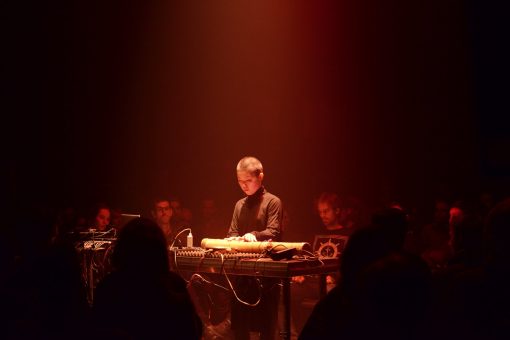
It’s not the first time to visit in Aberdeen. 4 years ago, Mei Yi (Percussionist) and I went there, performed several pieces of mine, invited by sonADA festival, which my dear friend and admired composer Suk-Jun Kim is organizing. This time I went alone, performed ‘Strings,’ ‘Singing Bowl,’ and ‘Two Bamboos,’ the most recent live sets. Although it was quite demanding to perform several sets at once, but I had a pleasant time! When you are performing at one festival second time, then you become a friend with it.
2. Rewire Festival 2018 //Apr
photo by Peter Balkema for 3voor12
It’s always great when performing at the local music festival. Since I’ve been in Den Haag, I have never had a chance to perform at Rewire, one of the most popular music festivals in Europe, and this time I got the honer and was very thankful about it. I performed a newly developed set with Bamboo and Gong at Koorenhouse hall, the very heart of the center. It was great, especially you know that most of your local friends are in front of you!
3. ‘CHI’ vol.2 //Jun
Finally after so many years, the CHI volume 2 happened at Studio Loos, the dearest place. CHI Vol.1 happened in 2013, performing with Mei Yi and Sonolab, with a guest performer (Henry Vega at Vol1). This time, I composed two new pieces, ‘Rolling stones’ and ‘Drinking alone under the moon’ and performed a piece from Vol.1 ‘BamBoos,’ and another premiere of a piece for a Bass Drum, performed by Sonolab Duo. The guest performer was Yota Morimoto, another dear friend from my first year in NL. After very nervous stressing time passed, it was very relieving to perform all the pieces. I hope this series could continue.
4. TodaysArt Festival – Azimuth-x //Sep
photo by Mike Rijnierse
Normally Azimuth invites composers/performers to perform with their specific multichannel system, but this time was MONO! It was special as the concert was part of the TodaysArt Festival in Den Haag! I performed a newly developed set ‘Cross Wired’ :the main idea was to modulate a CV voltage with an analog amplifier with feedback signal. This chaotic signal was enough to manipulate with the signal processing. But still I needed some more materials to fill 30 minutes of performance. So I added some voice and processing at the intro, explaining what I am actually doing physically, but the audience can’t understand what I am talking about in time, as the sound is turning into a very noisy sound. It was really fun.
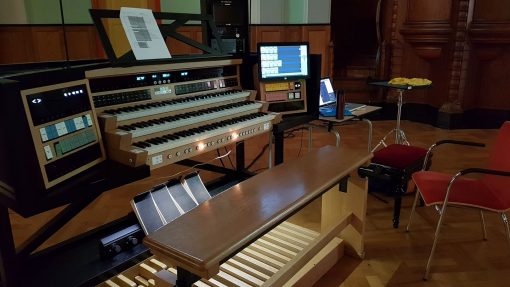
5. UTOPA Organ – Conlon & Orgelpark //Nov
UTOPA Baroque organ is a special organ that one can control its keys/stops/registers via MIDI or OSC. This gigantic machine(?) was quite challenging as it can do a number of different things that normal Baroque organ can’t do, such as air control, making continuous pulses/staccato, controlling each register individually, etc. I thought it’d be a good idea to make the concept and the piece simple, so that I focused on the characteristics of the organ as a ‘Machine.’ Accordingly the title of the piece is ‘Machine Breathing .’ The project is commissioned by Orgelpark. We, the Conlon foundation, were participacing the project as a composer and also as an assistant for other composers.
6. Pentacle 15.3 – NEXT Festival, Bratislava //Nov
photo by Nina Mik
It was an exciting opportunity to perform in Bratislava, as it was the first time in Slovakia, and I could meet some old Sonology friends who are very active there. Above all, the commission is to perform a live electronic muisic for 15.3 channel Pentacle system! Commissioned by NEXT Festival and SonicActs Amsterdam, I could perform with it. Pentacle is developed in STEIM by Fedde ten Berge and Jesse Meijer. The spatialization works with audio signal using FFT bins. All the composers did a few days of residency in STEIM and the NEXT festival was the premiere. I renewed the live set with two Bamboos and a gong. I had a wonderful time there.
7. PRISM#1 – Live music for Live film projection by Lichun Tseng //Dec
Ever since I worked with Filmwerkplaats Rotterdam, I missed working with them. And dear Lichun Tseng, one of the filmmakers there offered me this chance to make a live sound for her live film projections with 16mm projectors. This time at Nantes, France, we performed 40 minutes of live set. We practiced only 2 days, due to the complexity of booking the location and her heavy loaded setup, so it made us nervous, but we made it well. We drove 9 hours to Nantes, was quite an adventure, but all were memorable.
I am again looking forward to this year’s activities! Hopefully another productive year!
How was your year? It’s always exciting to look forward to a new year, making and setting up a fresh plan with a full of motivation! At the same time, it is very important to think about the past year, what are the achievements, and what I have missed.
This post is about my memorable activities of the year 2017. I selected 4 activities:
DELETION at International Film Festival Rotterdam
‘DELETION’ is a short film made by Esther Urlus, who I met two years ago for Light Leak project with Filmwektplaats. She’s a special filmmaker in The Netherlands, who create DIY 16mm experimental films. The length of the film is around 10 minutes, completely abstract, accordingly there was enough space for me to explore with sounds. The film is about a murder scene -accordingly, a horror movie!- but you don’t see or recognize anything through the screen. The story is behind the complete abstract scenes. The soundtrack therefore has a big role for audience to follow the story line.
Thankfully this film was nominated at Tiger Competition for Short Films 2017 at IFFR, which gave me a totally new experience to attend the festival, sitting there with other amazing filmmakers and actors/actresses. Even though the film wasn’t the winner, it was for me a great achievement. I hope to have more opportunities working on films. I quite like it.
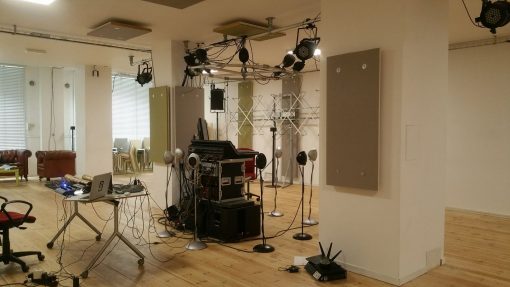
Azimuth #3
‘Azimuth’ is a foundation that their multichannel system offers composers/artists to create spatial music/arts with the system. Azimuth #3 was my first experience with it. The piece I wrote is ‘Punky-Pulse-Pool’ for 32 channels.
The materials were created from a short theme, a gesture using pulse oscillator, and as in variations on a theme, it was developed, manipulated, and re-synthesized into diverse forms. Then instead of presenting them one after another, they were massively and randomly thrown in time and in space. As if one freely plays a puzzle with multiple different blocks, the layered and squeezed sound materials are then sculpted and re-organized not only musically but also spatially. In that way new relationships between sound events are revealed, and the allied, survived sound parts are newly developed from there with a found connectivity.
I wrote the blog post about my experience in more detail.
‘Bamboos’ for Bamboos
Some might remember those Bamboo instruments that I made a piece for some years ago. Then I wanted to do something different with it, and here I made a live piece using them. Here I use(make) them as resonating ‘electronic flutes’ using audio feedback system. When I close the holes, their original tone varies. The feedback works like ‘breathes.’ Then I apply a number of signal processing. Together with it, I attached small metal rings on the holes that are wired to Arduino that gives a low voltage flow. My touch could change its voltage as I am also connected to another analog circuit. In other words, the voltage flows throughout my body and whenever the contact is made between me and the instruments, it changed. The variation is chaotic, unpredictable. Then this signal is added to the feedback sound, which is related also to the movement of my fingers. The program note for the piece is below.
Notes on “Bamboos”: Bamboos, their bodies, their own resonating voices. Every other gesture drives from there, as the performer continuously tries to distort, differentiate, and control them until the instruments and performer become strongly linked together. The whole space, occupied by bamboos’ stubborn voices whose struggles are running and jumping all over, later on becomes part of the resonating body, singing and breathing all together.
Staff at the Institute of Sonology
Probably the most surprising news was that I became a staff member in Sonology, where I studied and achieved Master Degree, for which I came here in The Netherlands. Somehow, probably it was my dream, one day, teaching here. Luckily and thankfully I got this opportunity.
The subject I am teaching is ‘Spatial Music Composition for WFS system.’ The course is designed for students to plan and proceed their project with the WFS system and I give lectures on Spatial music with tons of musical examples of other composers, history on spatial music and spatialization system/tools, the meaning of space, musical space, and practical knowledge on how to use the WFS system. It demands quite some research that I enjoy very much. It is definitely a new experience for me, and there is far more to become better.
Well, that’s it. Now it’s the beginning of the new year 2018. I am very much looking forward to seeing what will come to my life. Hopefully it becomes a very creative, more musical, and inspiring year. It’s mostly up to me.


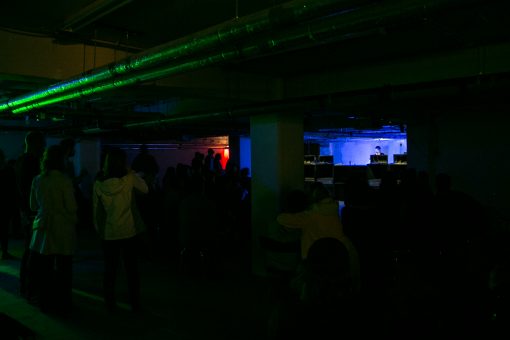
 ‘Azimuth’ is a foundation that their multichannel system offers composers/artists to create spatial music/arts with the system. Azimuth #3 was my first experience with it. The piece I wrote is ‘Punky-Pulse-Pool’ for 32 channels.