[Lab02] Some notes on Inverter, Theory, and Reality 이론과 실제의 간극, 그리고 인버터의 이모저모

The experiments I’m introducing were conducted about three years ago, so the vividness of those moments might have faded a little. However, the most valuable discovery from that time was not just the fact that I completed the circuits, but that I got a true taste of the gap between theory and reality.

Typically, when creating variations in a circuit, the first element people look to is the resistor. I’ve previously shown examples using a xylophone as a resistive body. However, the most interesting harvest from this experiment (perhaps felt more strongly due to my lack of prior knowledge) was the change that occurred when swapping various capacitors.
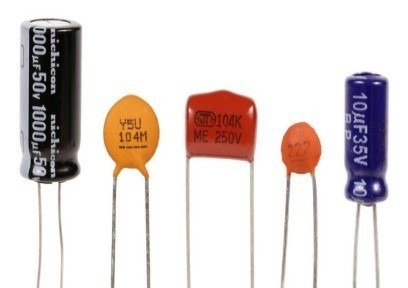
Various Capacitors

In reality, there are so many different types of capacitors. Depending on their material and construction (polarized or not, degree of stability, etc.), and how they are connected, the dynamics of the circuit change significantly. The calculated values in an RC circuit are actually quite abstract figures; in a real-world environment, staying exactly at those numbers requires immense effort to prevent noise. For me, however, that discrepancy is exciting. As long as basic operation is guaranteed, all these unpredictabilities become meaningful.

While a change in resistance directly alters the frequency by slowing the flow of current, the capacitor not only sympathizes with that process but also becomes a key element in determining the timbre. Even with the same capacity, using a capacitor made of a different material changes the texture because the capacitor itself acts as a kind of filter. For those of us who handle circuits as musical material, this is an indispensable element.

Another thing that awakened my naivety was the role of feedback. My previous experience with feedback was primarily positive feedback in audio signals—a phenomenon where a specific frequency explodes and reinforces itself. Because I had focused mostly on unwanted howling or chaotic instability, adapting to the completely different nature of feedback found within a circuit was quite challenging. I wondered, “How can feedback create stability?” Believing that feedback always symbolized instability was a very one-dimensional thought.

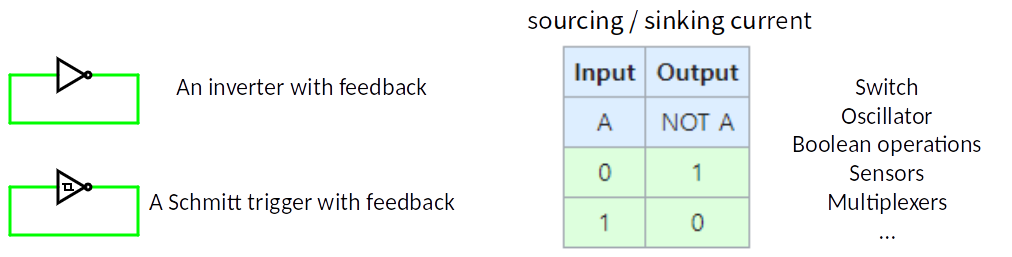
Feedback in a circuit mainly takes the form of negative feedback, where the output suppresses the input. The structure of an inverter oscillator utilizes this very principle. By returning the output to the input to constantly flip the state, with the speed controlled by R and C, a steady oscillation is created. In other words, feedback here serves as a stabilizer that sustains the oscillation while keeping the system within a specific orbit. The diagram below shows an abstract form of feedback without R and C.

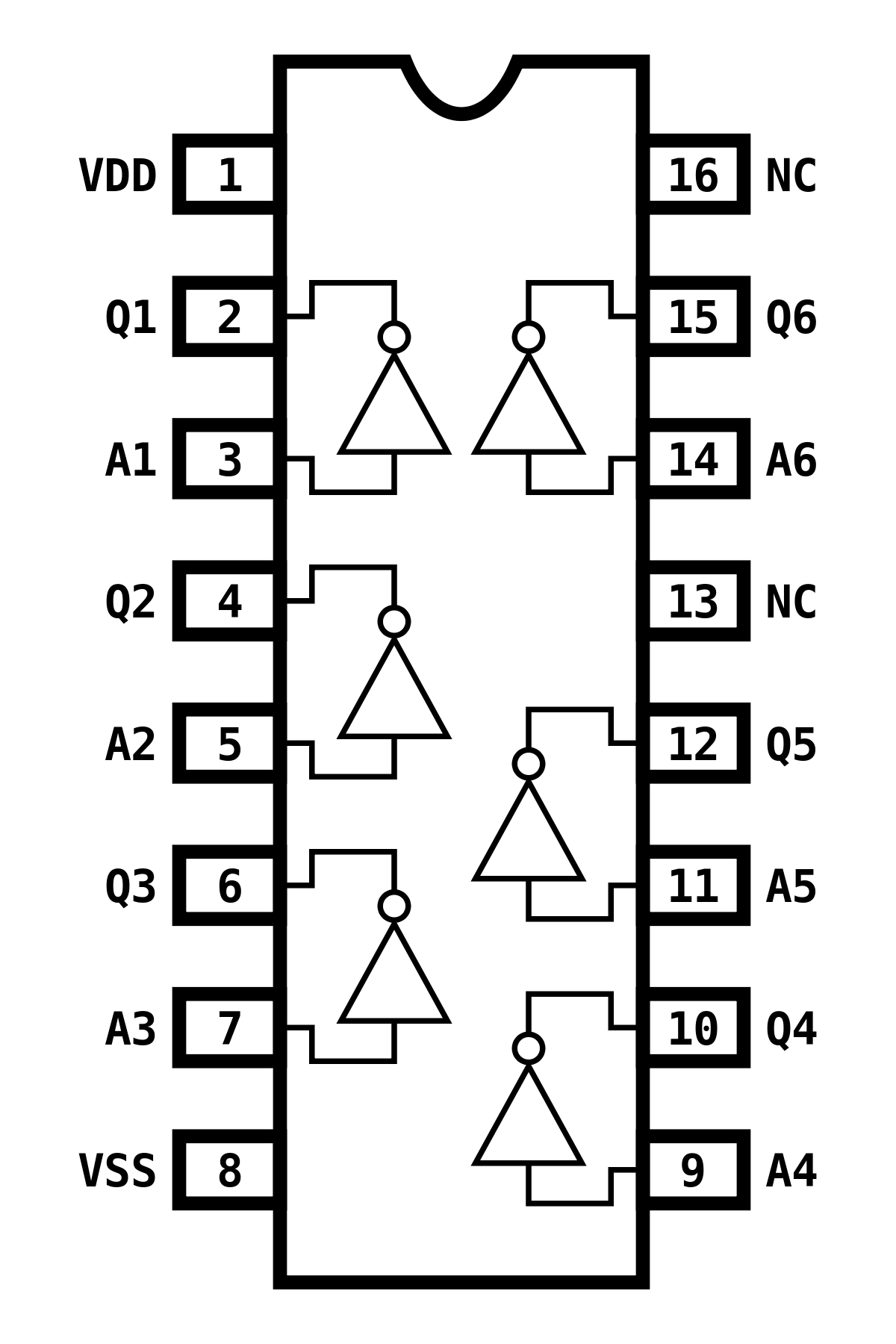
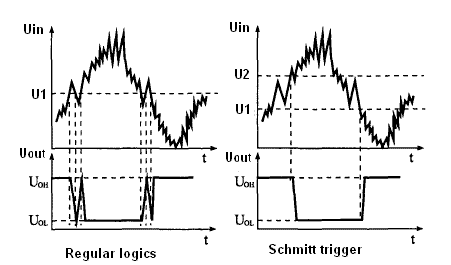
In the previous 4049 inverter experiment, I used ceramic capacitors to allow the voltage to swing between two points. When used to ‘copy’ and return a signal from a specific point, these are sometimes called ‘feedback capacitors.’ Since the 4049 lacks hysteresis, the transition between 0 and 1 is extremely sensitive and unstable. The numerous noises generated during this process mix into the output, which, from a tinkering perspective, becomes very interesting musical material. On the other hand, a Schmitt Trigger filters out such ambiguous noise sharply, making it more suitable for clean oscillator design rather than experimental purposes.

Furthermore, the 4049 has a random distribution of Vss and Vdd for each input, making the starting point difficult to predict. Without an initial connection, the voltage maintains a random value; the moment a connection is made, it starts operating from an already random voltage level. It’s a truly thrilling point.

A few more notes on inverters:

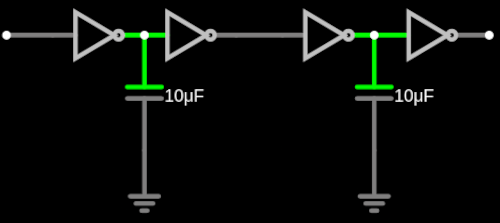
A series of inverters can create a delay, influenced by two main factors:

  1. Capacitor values: Capacitor Delay
  2. Gate latencies: Connecting an odd number of inverters in series is called a “ring oscillator.” A minute amount of time, measured in nanoseconds, is required for the signal to pass through each gate, depending on the IC chip’s design. Gate Latency

Note that an odd number of inverters must be connected for oscillation to occur. If an even number is connected, the output becomes latched to the same state as the input, and the circuit stays in one state without oscillating. Even Number Latch
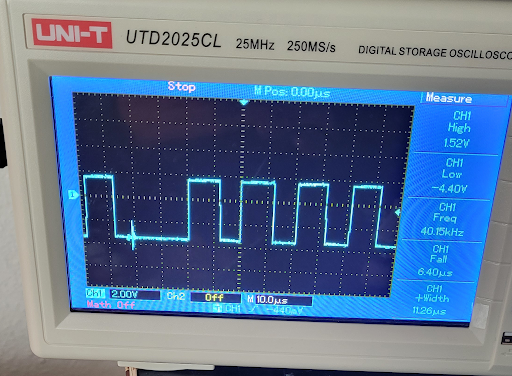
To create a distinct time delay audible to the ear in an analog circuit, a separate “clock” device is required. The gate latency method described above is closer to a phase shifter that subtly pushes the phase of the waveform, rather than a traditional delay, as it operates on a fleeting nanosecond scale.
[Lab 01] Crackle Inverter

I previously shared the background behind why I began these circuit experiments. However, starting something for the first time is always a challenge, as the initial point of departure sets the direction for everything that follows.

My choice emerged naturally from experience. When I first started these experiments, I was at a level where I could build very basic oscillators. Consequently, it felt intuitive to begin with the Integrated Circuits (ICs) I already had on hand. At the time, I had a sort of circuit practice toolbox that my friend Satoshi had passed down to me, which contained various IC chips. My starting point was to organize them, figure out what each one did, and pick one to work with. The most abundant chip in the box was the 4049 CMOS. I discovered it was a NOT gate; seeing that it simply outputted 1s and 0s, I thought it would be a perfect place to start.

Inverter (NOT gate)

An inverter, or NOT gate, is a fundamental component in digital circuits, designed to control input and output logic level voltages representing binary bits of 0 and 1. These binary values are depicted through voltage signals in relation to ground within the circuit. The functionality of an inverter extends to its ability to manage currents in two primary ways: Sourcing and Sinking.

Sourcing current involves connecting the output terminal to the IC’s power source (usually called Vcc), effectively “pushing” the current out. Conversely, Sinking current entails connecting the output terminal to the ground (often labeled as Vss), completing the circuit by “pulling” the electricity in to enable logic operations. To put it simply, it’s a component that “pushes and pulls” electricity.

Inverter Concept 1 Inverter Concept 2

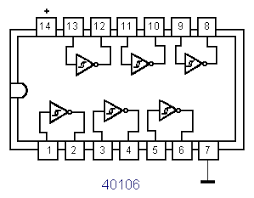
Another frequently used IC for inverters is the 40106, which contains six Schmitt triggers. A Schmitt trigger is an inverter with hysteresis. But what exactly is hysteresis?

It refers to a property where the output of a system depends not only on its current state but also on its past state. By setting different thresholds for “stepping up” and “stepping down,” the system avoids wavering in ambiguous middle zones. This allows the system to remain stable and unfazed by external fluctuations or minor noise. In short, it is a more stable, noise-filtered inverter, and it is preferred in oscillator design due to that very reliability. (See the diagram below)

Hysteresis Diagram 1 Hysteresis Diagram 2

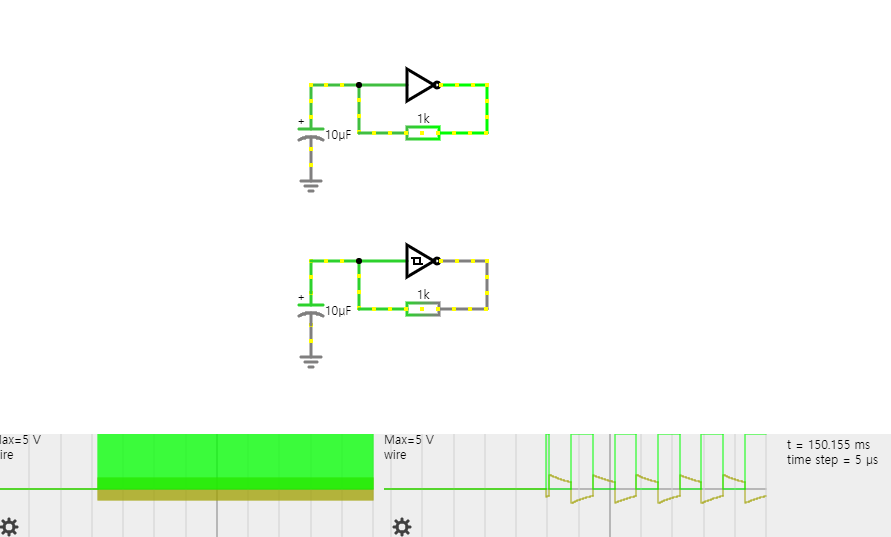
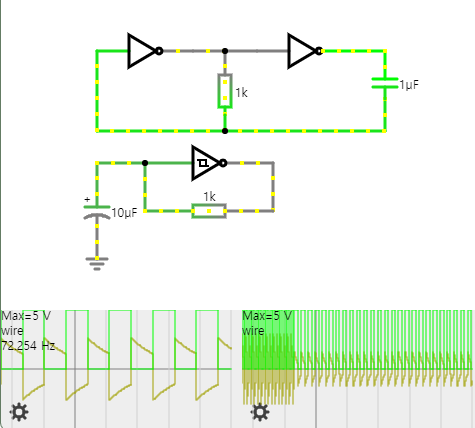
The interesting part of choosing between these two lies right here. Usually, one would choose the Schmitt trigger for its robustness against noise, as the 4049 seems to require a lot of effort to produce a clean square wave. To investigate further, I decided to compare the two side-by-side. This kind of comparison is an experiment that can only be done out of “ignorance”—a lack of prior knowledge. I designed the oscillators as follows:

Oscillator Comparison Design

Theoretically, in the design above, both should oscillate properly. The formula for calculating frequency is $1 / (RC \times t)$. I also learned that the value of $t$ (propagation delay) can usually be found in the datasheet. Looking at the waveforms at the bottom of the diagram, you can see that the frequencies of the two inverters are completely different. Specifically, the 4049 oscillator practically runs wild because it allows even the most minute changes to pass through. It’s a noise hellgate!

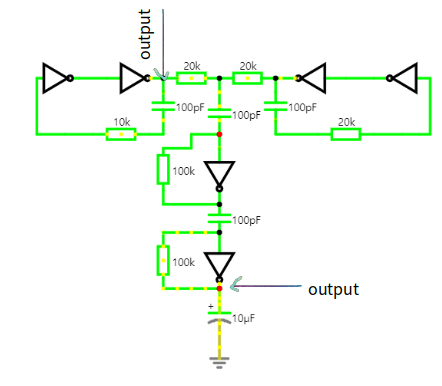
Consequently, I realized that to build an oscillator with the 4049, one must mix multiple oscillators together. In other words, you have to pass through various inverter gates to self-correct. The design is as follows:

4049 Mixed Oscillator Design

Through this experiment, my choice naturally gravitated toward the more “problematic” one. Starting with the 4049 and my first oscillator design, I built three oscillators into a single IC and began tinkering. I tried connecting different points, breaking connections, and replacing capacitors with different values or materials. The first circuit I created is shown below:

First Tinkered Circuit

At this point, a question arose: where should I listen to the sound? When working with analog, the starting and ending points are often unclear. For someone like me, who values tinkering over the “orthodox” way, the sheer number of choices was a bit paralyzing. So, I initially used the output junction shown above. When connecting to other equipment (e.g., a mixer), both devices must share the same ground, and the audio cable should not interfere with the signal flow. A good way to prevent this is to build a simple pre-amp using an Op-amp. I’ll explain the Op-amp some other time—that story is quite long!

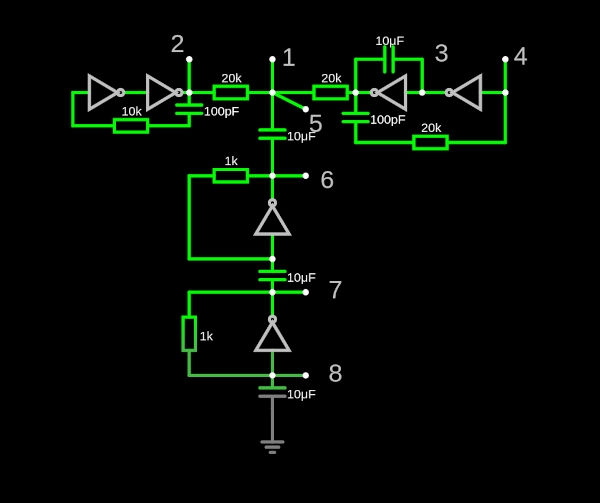
So, the final design came out like this:

Final Circuit Design

Each point is numbered; these are the contact points where I can interfere with the circuit in various ways. This idea was actually inspired by the Crackle Box. I created multiple contact points in advance so that the character of the circuit changes depending on how each point meets. Unexpectedly, it works quite well.

The following is a video of the test. This attempt eventually became the catalyst for composing my 2024 work, Cross-wired Xylophone.