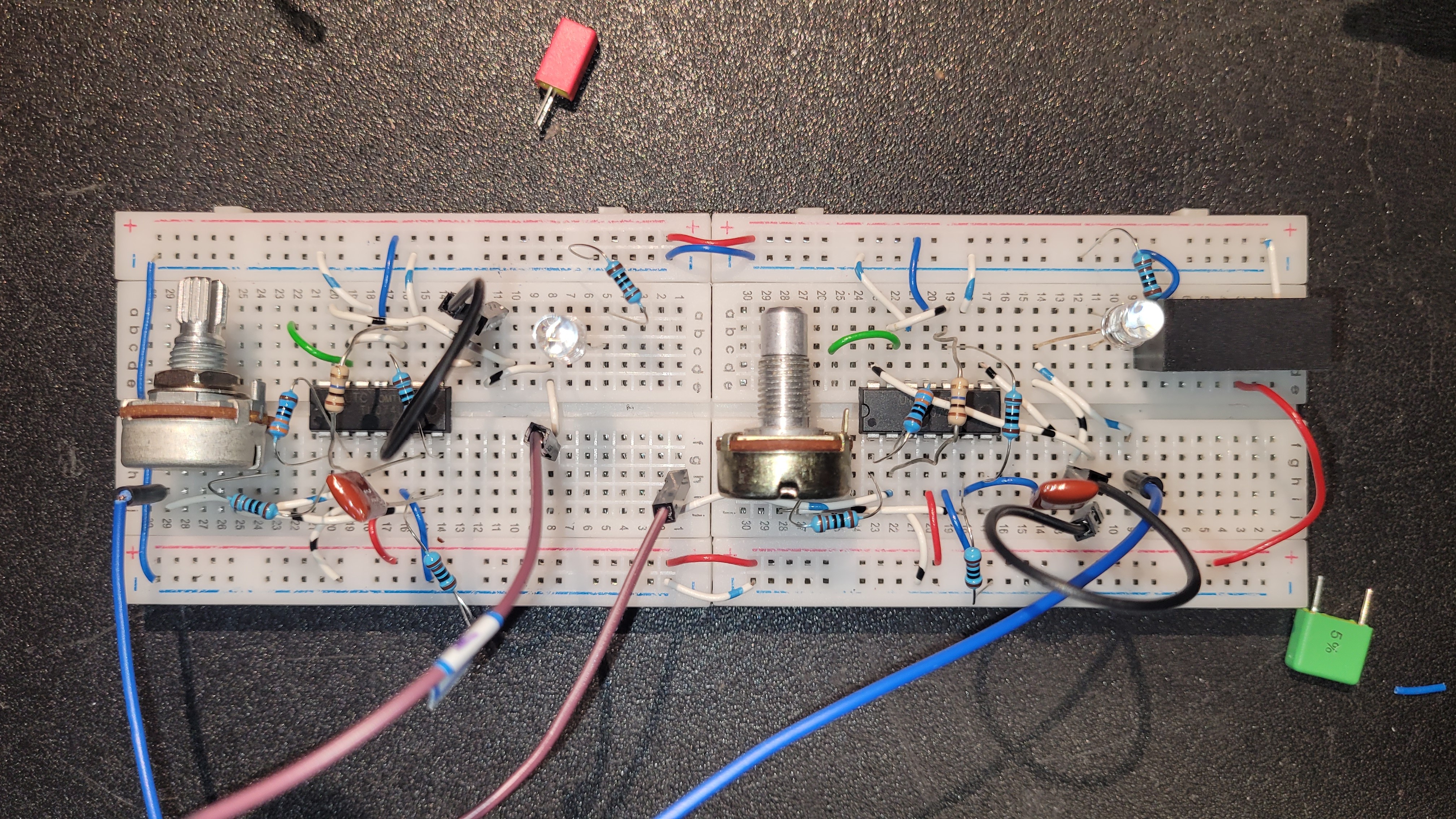
The experiments I’m introducing were conducted about three years ago, so the vividness of those moments might have faded a little. However, the most valuable discovery from that time was not just the fact that I completed the circuits, but that I got a true taste of the gap between theory and reality.
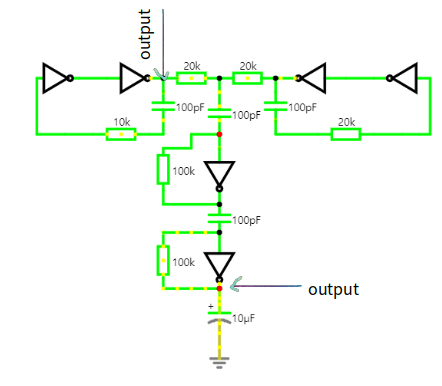
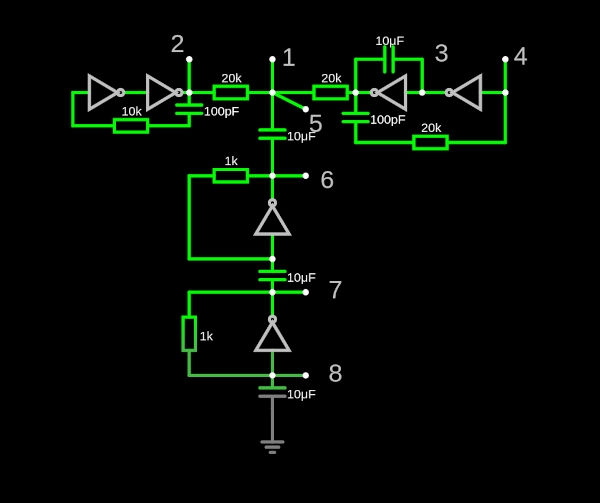
Typically, when creating variations in a circuit, the first element people look to is the resistor. I’ve previously shown examples using a xylophone as a resistive body. However, the most interesting harvest from this experiment (perhaps felt more strongly due to my lack of prior knowledge) was the change that occurred when swapping various capacitors.
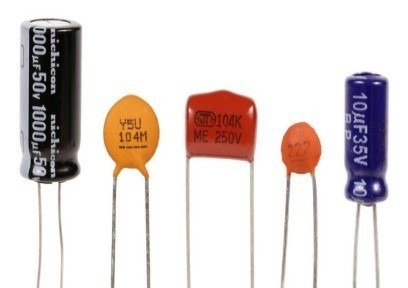
In reality, there are so many different types of capacitors. Depending on their material and construction (polarized or not, degree of stability, etc.), and how they are connected, the dynamics of the circuit change significantly. The calculated values in an RC circuit are actually quite abstract figures; in a real-world environment, staying exactly at those numbers requires immense effort to prevent noise. For me, however, that discrepancy is exciting. As long as basic operation is guaranteed, all these unpredictabilities become meaningful.
While a change in resistance directly alters the frequency by slowing the flow of current, the capacitor not only sympathizes with that process but also becomes a key element in determining the timbre. Even with the same capacity, using a capacitor made of a different material changes the texture because the capacitor itself acts as a kind of filter. For those of us who handle circuits as musical material, this is an indispensable element.
Another thing that awakened my naivety was the role of feedback. My previous experience with feedback was primarily positive feedback in audio signals—a phenomenon where a specific frequency explodes and reinforces itself. Because I had focused mostly on unwanted howling or chaotic instability, adapting to the completely different nature of feedback found within a circuit was quite challenging. I wondered, “How can feedback create stability?” Believing that feedback always symbolized instability was a very one-dimensional thought.
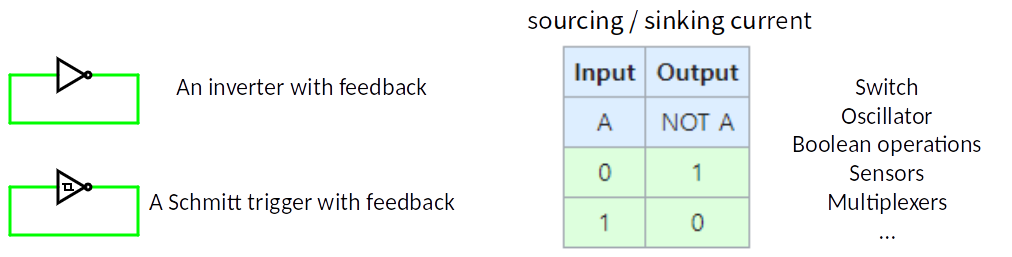
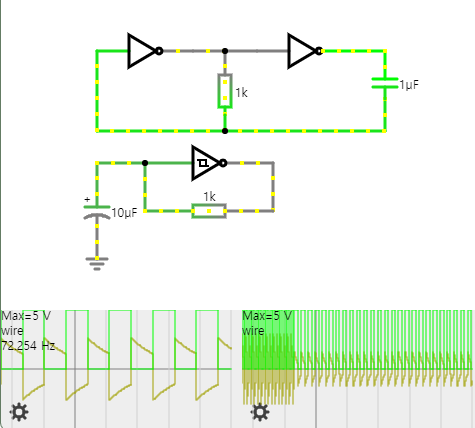
Feedback in a circuit mainly takes the form of negative feedback, where the output suppresses the input. The structure of an inverter oscillator utilizes this very principle. By returning the output to the input to constantly flip the state, with the speed controlled by R and C, a steady oscillation is created. In other words, feedback here serves as a stabilizer that sustains the oscillation while keeping the system within a specific orbit. The diagram below shows an abstract form of feedback without R and C.
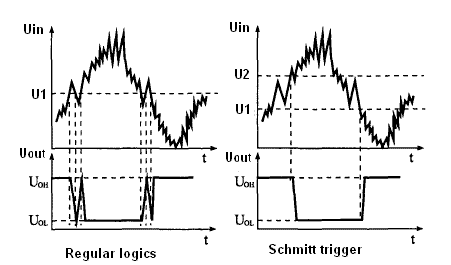
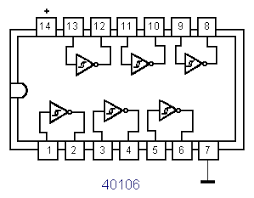
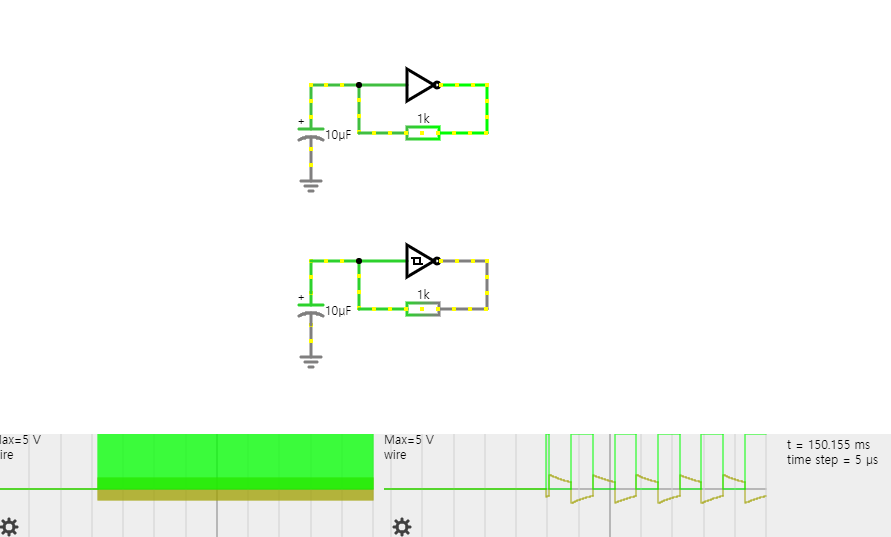
In the previous 4049 inverter experiment, I used ceramic capacitors to allow the voltage to swing between two points. When used to ‘copy’ and return a signal from a specific point, these are sometimes called ‘feedback capacitors.’ Since the 4049 lacks hysteresis, the transition between 0 and 1 is extremely sensitive and unstable. The numerous noises generated during this process mix into the output, which, from a tinkering perspective, becomes very interesting musical material. On the other hand, a Schmitt Trigger filters out such ambiguous noise sharply, making it more suitable for clean oscillator design rather than experimental purposes.
Furthermore, the 4049 has a random distribution of Vss and Vdd for each input, making the starting point difficult to predict. Without an initial connection, the voltage maintains a random value; the moment a connection is made, it starts operating from an already random voltage level. It’s a truly thrilling point.
A few more notes on inverters:
A series of inverters can create a delay, influenced by two main factors:
- Capacitor values:
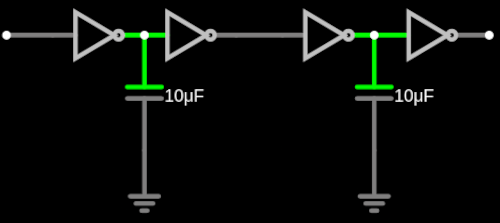
- Gate latencies: Connecting an odd number of inverters in series is called a “ring oscillator.” A minute amount of time, measured in nanoseconds, is required for the signal to pass through each gate, depending on the IC chip’s design.

Note that an odd number of inverters must be connected for oscillation to occur. If an even number is connected, the output becomes latched to the same state as the input, and the circuit stays in one state without oscillating. 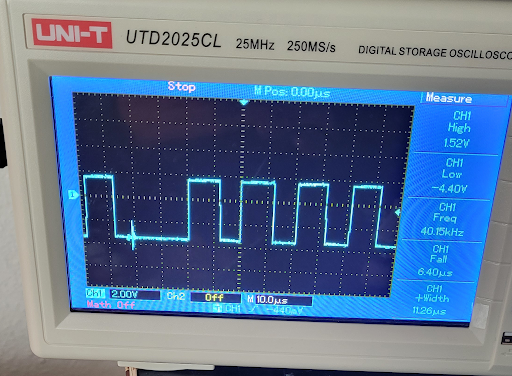
To create a distinct time delay audible to the ear in an analog circuit, a separate “clock” device is required. The gate latency method described above is closer to a phase shifter that subtly pushes the phase of the waveform, rather than a traditional delay, as it operates on a fleeting nanosecond scale.