Steve Goodman’s "Sonic Warfare: Sound, Affect and the Ecology of Fear"

 By

Geeta Dayal

on Wednesday, January 6th, 2010 at 1:00 pm.

9780262013475-f30.jpg

Cover of Sonic Warfare: Sound, Affect, and the Ecology of Fear by Steve Goodman

In Krystof Wodiczko’s striking installation Out of Here: The Veterans
Project
, currently on view at the ICA in Boston, choppers roar
overhead. People scream in the distance. Glass breaks and shatters on
the floor. The viewer can see almost nothing; the large room is dark,
except for a few windows high above, created by a row of video
projections. The view from these windows is obscured; the piece is as
much about what you can’t see than what you do see. But even more
importantly, the piece is about what you hear–and what you can’t
hear. The chants of an imam become the sounds of women wailing.
Gunshots begin to fire sporadically. Military officers yell harsh
commands. The rumble of bass—a swarm of Humvees in the distance,
drawing closer—gets louder and more threatening. The longer you stay
in the room, immersed in the increasing racket, the more palpable the
sense of dread becomes. The harrowing sounds of war are not simply
about the sounds themselves, but the spaces in between.

In the intriguing new book Sonic Warfare: Sound, Affect, and the Ecology of Fear [MIT Press], Steve Goodman
explores the power of sound as a tactic of irritation, intimidation,
or even permanent harm. Goodman analyzes “environments, or ecologies,
in which sound contributes to an immersive atmosphere or ambience of
fear and dread–where sound helps produce a bad vibe.”

Goodman catalogs a litany of military uses of sound that seem like
sinister science fiction fantasies. The “Urban Funk Campaign” was a
suite of audio harassment techniques used by the military in Vietnam
in the early 1970s. One such technique was called “The Curdler,” or
“People Repeller,” a panic-inducing oscillator with the ability to
cause deafening impact at short distances. The Windkanone, or
“Whirlwind Cannon,” was a sonic weapon planned by the Nazis. The
“Ghost Army” was a unit of the U.S. Army in World War II that
impersonated other units to fake out the enemy, employing an array of
sonic deception techniques with the help of engineers from Bell Labs.
“The Scream” was an acoustic weapon used by the Israeli military
against protesters in 2005. That same year, the Israeli air force
deployed deafening sonic booms over the Gaza Strip—producing powerful
physiological and psychological effects. “Its victims likened its
effect to the wall of air pressure generated by a massive explosion,”
Goodman writes. “They reported broken windows, ear pain, nosebleeds,
anxiety attacks, sleeplessness, hypertension, and being left ‘shaking
inside.’ “

The physiological effects of sound get an extended discussion via the
concept of infrasound, or sub-20 Hz bass frequencies, which are
legendary for inducing bodily harm. Fantastical tales about infrasound
and its infamous effects on the human body abound in popular lore.
Infrasound devices generally require huge, heavy rigs to produce such
powerful waves, which limit their practicality. One of the book’s most
fascinating accounts is the story of the wily scientist Vladimir
Gavreau, who did bizarre experiments with infrasonic waves in his
French laboratory in the 1960s. According to Goodman, one such
experiment caught
Gavreau and his team in a “vibratory “envelope of death,” where they
“allegedly suffered
sustained internal spasms as their organs hit critical resonance frequencies.”
Goodman seizes upon these outer limits
of sound – infrasound at the low end, and ultrasound at the high end –
and explores them extensively. For him, infrasound and ultrasound, at
the edges of our range of perception – illustrate the “unsound,” as he
terms it, the “not yet audible.”

Freakish military devices like “The Curdler” may seem like footnotes
of the historical record–curiosities from wars staged in far-flung
lands. But these devices also hit close to home. Last September,
police in Pittsburgh utilized a device known as the LRAD (Long Range
Acoustic Device) cannon against G20 protesters — the first documented
use of one of these acoustic cannons against civilians in the United
States. At top volume, the cannon is capable of emitting high-pitched
warning tones at 146 decibels — loud enough to cause permanent
hearing damage.


Video: Use of the Long Range Acoustic Device at the G20 Summit Protests in Pittsburgh, September 2009
(Source: Sonic Warfare blog)

How do we make sense of these uses of sound? Goodman sidesteps a
full-on historical survey of the subject. Nor is he interested in a
scientific analysis of the neurobiology of audition. Instead, he
presents a theoretical apparatus for understanding these acts of sonic
warfare, via thinkers such as Friedrich Kittler, Paul Virilio, and
Jacques Attali. Goodman argues for an “ontology of vibrational force,”
as a way of understanding “the not yet audible.” Goodman defines
vibrational force
as a “microrhythmic oscillation,” and uses the idea of
“rhythmanalysis”–a philosophy of
rhythm developed by the philosophers Pinheros dos Santos, Gaston
Bachelard, and Henri
Lefebvre—to advance his argument.

Along the way, Goodman delves into a bewildering array of references
from the worlds of
philosophy, psychoacoustics, art, music, and military strategy. The
Futurists’ fixation with noise, war, and speed figures in here, from
Luigi Russolo’s famed tract “The Art of Noises” to Marinetti’s fevered
exultations: “Load! Fire! What a joy to hear to smell completely
taratatata of the machine guns screaming a breathlessness under the
stings.” So, too, do the discourses of Afrofuturism, the surreal
fictional landscapes of William S. Burroughs and J.G. Ballard, the
1984 cult film Decoder, “audio
viruses,” Deleuze and Guattari’s theory of the refrain, Jamaican sound
systems, the work of the sound artist Mark Bain, and the “Mosquito
Anti-Social Device,” a high-frequency tool designed to prevent UK
teenagers from loitering.

Sonic Warfare is a heady, sprawling read, densely packed with detail.
Goodman’s wide range is, in part, influenced by his background. In
addition to being a writer and theorist, he doubles as an accomplished
producer of dubstep under the alias kode9, wandering a subterranean
world of bone-rattling bass pressure, towering speaker stacks, and
crowded rooms. His unique dual existence makes him strangely – and
ideally – suited for a book which requires not only an understanding
of theory and history, but also a close and personal understanding of
the powerful physicality of sound itself.

Geeta Dayal is the author of Another Green World
(Continuum, 2009), a new book on Brian Eno. She has written over 150
articles and reviews for major publications, including Bookforum, The
Village Voice, The New York Times, The International Herald-Tribune,
Wired, The Wire, Print, I.D., and many more. She has taught several
courses as a lecturer in new media and journalism at the University of
California – Berkeley, Fordham University, and the State University of
New York. She studied cognitive neuroscience and film at M.I.T. and
journalism at Columbia. You can find more of her work on her blog, The Original Soundtrack.

Call for Handmade Music Amsterdam! Feb 17, 2010

 Call for Handmade Music Amsterdam! Feb 17, 2010


For the next Hotpot Lab we will be inviting Peter Kern from createdigitalmusic and will host a Handmade Music event. We would like to invite instrument builders, hackers and tinkerers to show their invention and self-built instruments. Send us an email if you want to participate!


More info at http://www.steim.nl


STEIM
(studio for electro instrumental music)
(studio voor elektro instrumentale muziek)

Achtergracht 19
1017 WL Amsterdam
Nederland

tel 00 31 (0) 20 6228690
fax 00 31 (0) 20 6264262
WEB SITE : http://www.steim.nl
STEIM mailing list
STEIM@list.xs4all.nl
https://list.xs4all.nl/mailman/listinfo/steim

Xenakis exhibition in NYC

Gone but not, not forgotten

Posted by Steve Layton

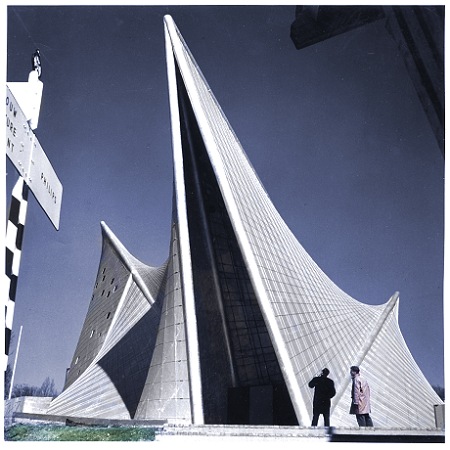
PhilipsPavilion1958-450

An illegal immigrant with a civil engineering degree in Paris,
fugitive from his native Greece for his WWII resistance activity (for
which he nearly died, and lost one eye) Iannis Xenakis (1922-2001) eventually found himself working for the famed architect Le Corbusier,
first as one of any number of assistants but soon enough as
collaborator. Yet he was always drawn above all else to the need to
compose music. Nadia Boulanger, Arthur Honneger, Darius Milhaud –all
were either rejecting or rejected. It wasn’t until Xenakis stumbled
upon Olivier Messiaen that he found a teacher that saw past the
inexperience and willfullness:

I understood straight away that he was not someone
like the others. […] He is of superior intelligence. […] I did
something horrible which I should do with no other student, for I think
one should study harmony and counterpoint. But this was a man so much
out of the ordinary that I said… No, you are almost thirty, you have
the good fortune of being Greek, of being an architect and having
studied special mathematics. Take advantage of these things. Do them in
your music.

Thrown
almost at once into the hotbed of post-WWII modern music, surrounded by
the likes of Karlheinz Stockhausen, Pierre Boulez, Jean Barraqué and
Pierre Schaeffer, yet still working for Le Corbusier, Xenakis soon
found ways to integrate his love of mathematics and architecture with
new musical forms based on points and masses, curves and densities,
later even physics and statistics — but somehow always tied to a deeply
Greek historical and humanistic root system.

In the late 1950s Le Corbusier received a commisson to create the
Phillips Pavillion for the 1958 Brussels World’s Fair. Le Corbusier
made a preliminary sketch, but it was Xenakis who would develop and see
the structure through to completion. Not only that, Xenakis (along with
Edgard Varèse) would create music to inhabit the space, complementing a
multi-projection visual program by Le Corbusier himself.

While only standing a short time, the echo of that space, event and
music would continue well past 1958; it was constantly mentioned in all
the books while I was a university student, and the pieces made for it
have become “classics” in the field of early electronic music, still
listened to and loved today. (There’s a small documentary on the Pavilion that you can see on YouTube.)

The reason I’m telling you all this? Because from January 15th through April 8th, The Drawing Center in New York City is hosting the show Iannis Xenakis: Composer, Architect, Visionary. And in conjunction with this show, the Electronic Music Foundation is sponsoring a number of Xenakis events, including on the 15th a virtual recreation of the experience of the Phillips Pavilion at the Judson Church (55 Washington Square South).

We’ve asked The Drawing Center’s Carey Lovelace and the EMF’s own Joel Chadabe to give us some background and info, which follows just after the jump:

EYECATCHING AVANT-GARDE MUSIC
Iannis Xenakis:  Composer, Architect, Visionary, The Drawing Center, NYC, January 15-April 8
By Carey Lovelace

At a premiere New York alternative art
spaces, The Drawing Center, Iannis Xenakis: Composer, Architect,
Visionary, starting January 14 , will feature the first exhibition ever
devoted to the visual aspect—which was substantial–of the legendary
avant-gardist’s work.  Not only was Xenakis a pioneer of the use of
advanced mathematics as an organizational compositional tool, he
created captivating working studies and sketches that charted out his
ideas before their translation into notation or into electronic or
computer works.
This visual acumen resulted from his
background.  Originally trained as an engineer, in the 1950s, Xenakis
worked with the Swiss-French Modernist Le Corbusier.  Indeed,
currently, he himself is gaining almost cult-status among architects.  
(The combination of music and building is au courant— the noted Stephen
Holl designed the Stretto House in 1989, based on Bartok’s Music for
Strings, Percussion and Celeste.)

The Drawing Center show, which runs
through April 8, is drawn from nearly a hundred documents housed in the
Bibliotheque Nationale de France’s archives, placed there shortly
before Xenakis’s death in 2001.
The show was curated by scholar Sharon
Kanach, translator and editor of his works, and Carey Lovelace, a
New-York based critic and curator.  (The two met as young American
composers in Xenakis’s class at the Sorbonne, where he taught until
1989.)    The visual strength of the studies, sketches, tables of
calculations, Cartesian grids, and conceptual renderings, are so
beguiling that art connoisseurs might mistake them for gallery
works–even though they were simply casual preparatory documents.  .

To give a sense of the music resulting,
 Ipods will be provided with recordings of the works on view; 
“listening stations” will allow viewers to experience two works,
Pithoprakta and Mycenes Alpha, in conjunction with the a running
display of the visuals that generated the sound.
And yet, there is more!  Among the array of
public programming accompanying this exhibition is colloquium, Xenakis
Past, Present and Future, Jan. 28 through 30 at the Brooklyn
Polytechnic, slated for attendance by dozens of musicians, scholars and
specialists from around North Amercia.  It will focus on the impact of
this polymath’s mathematical paradigms, architectural contributions,
utopian speculations, musical advances, and rigorous approach.
 Earlier, a “triple gala” on Jan. 19 will inaugurate the Xenakis
Project of the Americas, devoted to the propagation of the legacy of
the Roumanian-born, Greek-bred, Paris-based composer.  The event, an
invitational benefit, will also launch of the book Performing Xenakis,
edited by Kanach.
………………………………………………………………..

LE POEM ELECTRONIQUE

January 15, Judson Church, NYC

By Joel Chadabe

In conjunction with The Drawing Center
exhibition, a series of public performances featuring the multi-faceted
work of composer/architect Iannis Xenakis will take place in New York
City.  The series will launch on January 15 with the virtual-reality
rendering of the Philips Pavilion created for Brussels 1958 World’s
Fair.

As I
view it, the Philips Pavilion, designed by Iannis Xenakis for the
World’s Fair in Brussels in 1958, is a remarkable building. Xenakis was
working for Le Corbusier, at that time one of the most widely
celebrated architects in Europe, who had received the call from Philips
asking him to design their pavilion. He responded, “I will build you a
poème électronique …” and he delegated the design to Xenakis. As
Xenakis told me in a conversation in 1994, “They asked Le Corbusier to
design something and Le Corbusier asked me to design something. At that
time, I was very much interested in shapes like hyperbolic paraboloids,
things like that; and so I organized them to form a shell in which we
could produce sounds and images on the walls. I did the designs and I
showed them to Le Corbusier and he said, ‘Yes, of course.’”


The
multimedia spectacle, organized by Le Corbusier, that took place within
the pavilion was also remarkable. The World’s Fair opened in May 1958.
About 500 people entered and left the pavilion every ten minutes or so
every day, accompanied by Xenakis’ Concret PH, a short piece composed
with the sounds of smoldering charcoal. The main event consisted of
Edgard Varèse’ Poème Electronique, with the sounds of percussion,
electronic tone generators, machines, and the human voice played
through 400 loudspeakers, with the sounds moving through space
according to ’sound routes’; and colored light forming a background to
Le Corbusier’s projected images of monkeys, shellfish birds, religious
objects and art from different cultures, parts of the Eiffel Tower,
Laurel and Hardy stills, nuclear explosions and other war imagery, and
buildings from different countries. The result was a total experience
of sound and image, a total immersive environment with the space of the
Pavilion hosting the musical and visual materials as integral parts of
the architectural design.


On
January 15th At Judson Church in New York, EMF is re-creating the
multimedia spectacle that was organized by Le Corbusier in 1958.
Audiences will hear Xenakis’ Concret PH as they enter and leave. They
will see the projections chosen by Le Corbusier accompanied by Edgard
Varese’ Poème Electronique. The show, with a duration of less than 15
minutes, will take place every half hour, at 7:30, 8, 8:30, 9, and
9:30pm. Admission will be $1 per show per person.