I have found this topic on -music- notation quite fascinating. Here I am not talking about the technical or artistic point of view on the music notation, but the process and method in the action of notating.
When I was in University, the composition department kind of encouraged to submit the work hand-written. At the moment very few people were using notation softwares (my very first one was Encore in the mid 90′.) Students needed to submit two copies: one originally hand-written copy, and a photo copy of the original. I learned properly how to notate the score. For example, the space between note, how to make grid on the staff to properly align every object on the score, and so on. However before this process, we need to compose first, and my education of course taught me to do on the music sheet using pencil.
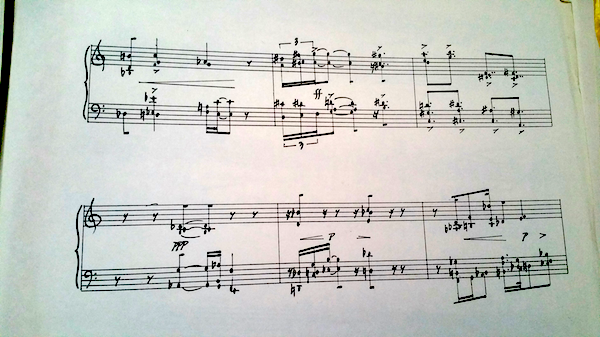
One of my very first handwritten scores from the university life
Before going into the story of composing with the pencil, I’d like to talk about my preference on writing with hands. I am programming a lot, and quite amount of hours of a day, I am sitting in front of computer, typing on keyboard (I can also talk about ‘keyboard!’ well, next time.) but I cannot let handwriting completely go away from my life because I love that process. I am slightly obsessed of some types of pen, pencil, and paper because of that. If I have a right pen and piece of paper, I can really enjoy writing. However, if not, I have a big trouble on writing. Because of that, whenever I find a nice piece of notebook or the pens I like, I must buy them and put them into my notebook collection. I was wondering why I have this tendency. This has happened since I was a young student, a middle school student probably, that I found myself enjoying writing more than anything else in the school life. My notebooks were quite popular in the class because of that. I was also trying to make a nice handwriting that goes nicely with my nice pen and notebooks. I have kept writing my diary also since then. Some of them are written with more care, and some are written not so nicely. And I have kept them all. Even when I read books, I write them down quite often. Just move the words from the book to my notebook. Yes I love writing, the physical process of writing: the feeling of my strength goes into the pen, and the pen smoothly touches the paper skin, and the letters are engraved on the paper, and after lines, it becomes a paragraph of letters, also looks beautiful to me, the beauty I don’t feel the same when I am reading printed books. Probably because printed letters don’t carry the strength, the very momentary strength whatever it is.
Of course the content is the most important one in terms of writing. However the writer should be able to enjoy the process. When composers create music, there are many different processes before a piece of music to be born: Searching for the idea, thinking about form, searching for the sounds, and so on. Then mostly those are notated. There are also many types of music that need a very little amount of notation, or no musical notation at all. Some of my compositions do not have a musical notation but a documentation. But this obsession on writing also gives me a number of challenges on finding out a new way to notate especially when working with a new instrument, or a completely new way of performing. Here in this post, I am probably more talking about more conventional writing.
I know a lot of my colleagues these days use notation programs during composing. I find it amazing. My brain somehow doesn’t allow me to do so. It is for me to jump between multiple dimension in different thinking/physical processes. It has lots of advantages: most among them could be that it saves lots of time. However, probably because of my education, where I needed to submit 6 pieces per year for 4 years, -considering that the school year without vacations only take 7 months- and all those times I was training to write notes on the paper. This was for me the fastest way. Later of the school year, I started using the notation program for submitting which was allowed from the 3rd year. But I needed to write first on the paper and in a couple of days before the deadline, all days and nights, I needed to move all those notes to the computer. This is completely a labouring job. Almost no creative thought involved, and that was completely welcome and needed after heavy composing period.
This habit has followed me till now. I am doing the same: writing first on the paper, then transcribing all the notes to the program. I have tried to compose with the software, but it just doesn’t work for me: I already forget what I was going to put in when I put the cursor on the screen on the right spot.
Several benefits come when it comes to handwriting composition:
-The time between thinking and writing becomes minimal. You can directly move your thought into the paper.(This can be very different from writing letters -story- on paper, which can be slower.) Rarely the idea or the thought come as the smallest fragment-notes-, but as a big chunk. I write that image first into a piece of paper, try to draw that idea, and indicate with the words what it is about. (This happens a lot more when it comes to electronic music composition. ) Then this drawing goes into the next step: sometimes goes straight into the sheet, or it probably needs a bit more details with more drawing, more indications and so on. This can be called as sketches. I wish I could just go straight into the sheet paper. Never happened.
-There always the second chance to look at what I write when I transcribe the piece into the computer. Since it is a very practical process, not really a creative one, I can easily find errors and mistakes, and can have a certain type of freshness on viewing the score. There some corrections follow in that process. It is quite difficult to find when directly composing with the software.
-Also you can do it wherever you want. You don’t need to carry your laptop. Actually you can get out of your online life for awhile and going back to somehow old fashioned working process that there is no distraction from any notifications; you sit with a pencil and a paper, and your idea.
There are several habits when I compose using pencil. I first sharpen the pencils. I have a set of pencils and I sharpen them all before starting working. Most of time I use those set till they get blunt and I finish the days’ work. So that tomorrow, I need to sharpen them again, and it is the start of the work. This became a rule and a ritual for me. The most painful moment before starting composing today, I sharpen them as slow as possible so that I can work a bit later, because when they are done, I need to start working! So this is the time for my mindset. I become ready to work, and it gives me a bit of time to remind myself what I need to write today.
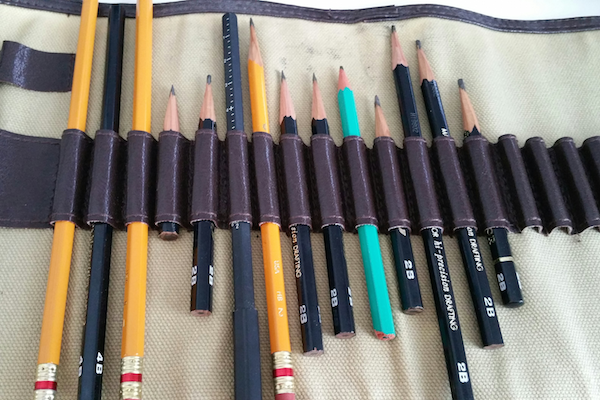
my pencil set for composing
When I finish sharpening, I draw bar lines (if necessary) and mark each beat on the top of the staff with very small dots. (For example, if you are writing in 4/4, I divide a bar into 4 using dots.) This mark gives me the sense of time flow like a metronome. Often just 1 minute of music can take several pages of sheet. Depending on the tempo, it is a time-consuming process. This is quite a tricky process; you need to keep the sense of the whole duration of the passage, and this is mostly decided in the planning -the big chunk drawing- and when moving into the sheet, you need to have a clear point on where it needs to start, speed up, and end. Marking the right time duration is essential because you need to go into micro second after all, writing each note when your actual time is much longer than what you write. Fascinating. Isn’t it?
I am not trying to chant on the handwriting process. It is a very personal choice. I only wanted to share my own perspective on the process, how important it is for me as the process of composing. It is important because I can feel the moment of writing later on. It delivers a kind of mood of the moment. It is a personal tracking system of the moment. It is important because it drags myself into the music. -No no, I am not trying to be spiritual here.- It holds my concentration and brings it even deeper. It makes me actualize my thought, from the drawing and planning, to the music. It gives me some kind of satisfaction, oh that can be quite a personal satisfaction since I like writing with hands.
Call me old fashioned, boring if you’d like. That’s okay because for me it is more important to find a joy of what I do. As long as I like writing with hands, I will probably continue composing, with pencil.