I mentioned that I’m preparing three or four different series, didn’t I? If you ask why I’ve suddenly started writing like this; well, I’ve actually written a lot over the years, but my primary reason now is that I’ve decided to write things that can be shared, rather than just keeping them to myself. I wanted to write freely about the books I read, the space I live in, the work I do, and my own thoughts.
That said, I can’t just write absolutely anything. I figured that organizing my writing into three (or perhaps four) major frameworks would make the process smoother, keep the content balanced, and perhaps even broaden my own perspective.
Above all, I have always loved writing. Even during my school years, I was constantly writing something. I thought it would be wonderful if I could take that thing I love and, with the help of a bit of a “system,” turn it into a medium, aside from music, that I can share with others.
There are moments while reading a book when you feel a sudden urge to write. There are certain authors who evoke that. Perhaps writing is a way of recording the intensive thoughts one has at a specific moment (unless one is writing a novel, though even novels, in a broader sense, reflect the author’s thoughts at the time). Some of the humble posts I’ve uploaded to this blog date back more than 20 years. What I am truly grateful for is that, looking back at those “insignificant” entries, I can re-read exactly what I was thinking two decades ago. This is a privilege reserved only for those who write. To be able to see my own thoughts from 20 years ago—how many people in the world actually get to preserve such moments?
What I was doing back then is important, of course. But tracking the evolution of my thoughts is truly vital. I am such a different person now than I was then, and I know that I will continue to change.
In any case, that is why I intend to keep posting. This “Signal” series will be an attempt to consciously draw connections between my life in the Netherlands and my work or music. My daily life acts as a signal for my work, and my work, in turn, sends signals back to my life.
While the “Lab” series will cover the trials and errors occurring within my studio, “Signal” will be about the stories happening outside of it.
Ah, my blog is quite old, so the categories don’t always organize themselves very well. Nevertheless, I trust that if there are long-time readers still around, they will navigate through them without much trouble.
And to anyone who takes the time to read this, thank you so much.
내가 준비하고 있는 시리즈가 3~4개 있다고 이야기 했던가? 갑자기 왜 이렇게 글을 쓰냐고 묻는다면, 사실 그동안 많이 써오기도 했지만, 이제 나 혼자 읽는 글이 아닌 공유할 수 있는 글을 써보기로 마음먹은 것이 첫 번째 이유다. 그리고 기왕 글을 쓰려면 내가 읽는 책들, 내가 사는 공간, 하는 일, 그리고 나의 생각들을 자유롭게 써 나가고 싶었다.
그렇다고 무조건 아무거나 쓸 수는 없다. 크게 3가지(혹은 4가지)의 큰 틀로 정리하면 여러 요소를 다룰 수 있어 글 쓰기가 수월할 것이고, 글이 한쪽으로 치우치는 일도 없을 것이며, 내 생각도 조금 더 넓어지지 않을까 싶었다.
무엇보다 나는 글 쓰는 것을 정말 좋아했다. 학창 시절에도 끊임없이 무언가 써왔는데, 내가 좋아했던 그 일에 시스템이란 힘을 빌려 음악 외에 공유할 수 있는 매체가 된다면 참 좋겠다고 생각했다.
책을 읽다 보면 글을 쓰고 싶어지는 순간이 있다. 그런 작가들도 있다. 어쩌면 쓴다는 것은 그 순간 하고 있는 집중적인 생각들을 기록하는 일이기도 하다(소설 쓰는 일이 아니라면—물론 소설도 크게 보면 그 당시 작가의 생각이 녹아 있지만). 내가 이 블로그에 하찮은 글을 올린 지, 정말 오래된 글들은 20년이 족히 지났다. 너무나 감사한 것은 그런 하찮음을 보며 20년 전 내가 하고 있던 생각을 다시 읽어본다는 것이다. 이것은 쓰는 자만의 특권이다. 내 20년 전 생각을 볼 수 있다니. 세상의 얼마나 많은 사람이 그런 순간들을 간직하는가.
그 당시 무엇을 했는지도 물론 중요하다. 하지만 생각의 변화를 읽는 것은 정말로 중요하다. 나는 그때와는 너무 다른 사람이 되어 있고, 앞으로도 계속해서 나란 인간은 변할 테니 말이다.
아무튼 그래서 글을 올리려 한다. 이 Signal이란 시리즈는 나의 네덜란드 생활에서 발견되는 것들과 나의 작업이나 음악과의 연관을 굳이 지어보는 일이 되겠다. 내 일상이 내 작업의 신호 역할을 해주고, 내 작업은 내 생활에 신호를 주는 것이다.
Lab 시리즈에서는 내 스튜디오에서 벌어지는 좌충우돌기가 되겠지만, Signal은 Lab 밖에서 일어나는 여러 이야기가 될 것이다.
아, 나의 블로그가 너무 오래되어서 카테고리가 잘 만들어지지 않는다. 그럼에도 불구하고 오래된 독자가 남아 있다면 별 불편 없이 하나하나 봐주리라 생각한다.
I previously shared the background behind why I began these circuit experiments. However, starting something for the first time is always a challenge, as the initial point of departure sets the direction for everything that follows.
My choice emerged naturally from experience. When I first started these experiments, I was at a level where I could build very basic oscillators. Consequently, it felt intuitive to begin with the Integrated Circuits (ICs) I already had on hand. At the time, I had a sort of circuit practice toolbox that my friend Satoshi had passed down to me, which contained various IC chips. My starting point was to organize them, figure out what each one did, and pick one to work with. The most abundant chip in the box was the 4049 CMOS. I discovered it was a NOT gate; seeing that it simply outputted 1s and 0s, I thought it would be a perfect place to start.
Inverter (NOT gate)
An inverter, or NOT gate, is a fundamental component in digital circuits, designed to control input and output logic level voltages representing binary bits of 0 and 1. These binary values are depicted through voltage signals in relation to ground within the circuit. The functionality of an inverter extends to its ability to manage currents in two primary ways: Sourcing and Sinking.
Sourcing current involves connecting the output terminal to the IC’s power source (usually called Vcc), effectively “pushing” the current out. Conversely, Sinking current entails connecting the output terminal to the ground (often labeled as Vss), completing the circuit by “pulling” the electricity in to enable logic operations. To put it simply, it’s a component that “pushes and pulls” electricity.
Another frequently used IC for inverters is the 40106, which contains six Schmitt triggers. A Schmitt trigger is an inverter with hysteresis. But what exactly is hysteresis?
It refers to a property where the output of a system depends not only on its current state but also on its past state. By setting different thresholds for “stepping up” and “stepping down,” the system avoids wavering in ambiguous middle zones. This allows the system to remain stable and unfazed by external fluctuations or minor noise. In short, it is a more stable, noise-filtered inverter, and it is preferred in oscillator design due to that very reliability. (See the diagram below)
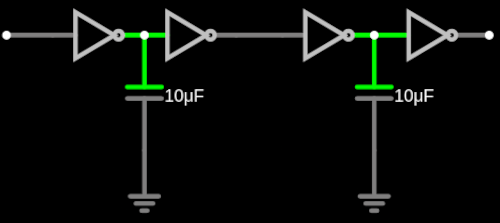
The interesting part of choosing between these two lies right here. Usually, one would choose the Schmitt trigger for its robustness against noise, as the 4049 seems to require a lot of effort to produce a clean square wave. To investigate further, I decided to compare the two side-by-side. This kind of comparison is an experiment that can only be done out of “ignorance”—a lack of prior knowledge. I designed the oscillators as follows:
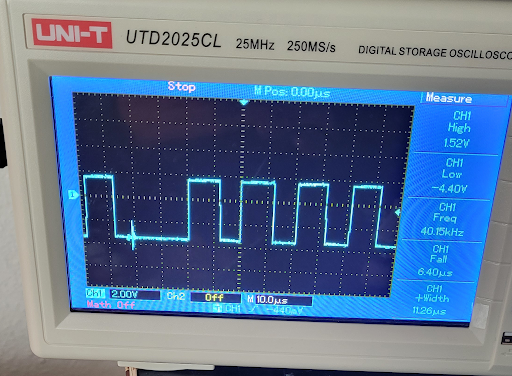
Theoretically, in the design above, both should oscillate properly. The formula for calculating frequency is $1 / (RC \times t)$. I also learned that the value of $t$ (propagation delay) can usually be found in the datasheet. Looking at the waveforms at the bottom of the diagram, you can see that the frequencies of the two inverters are completely different. Specifically, the 4049 oscillator practically runs wild because it allows even the most minute changes to pass through. It’s a noise hellgate!
Consequently, I realized that to build an oscillator with the 4049, one must mix multiple oscillators together. In other words, you have to pass through various inverter gates to self-correct. The design is as follows:
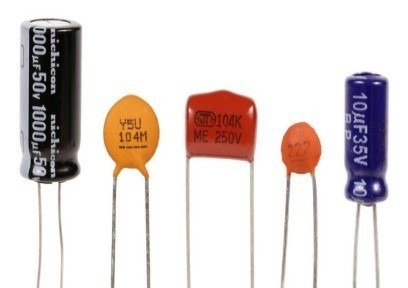
Through this experiment, my choice naturally gravitated toward the more “problematic” one. Starting with the 4049 and my first oscillator design, I built three oscillators into a single IC and began tinkering. I tried connecting different points, breaking connections, and replacing capacitors with different values or materials. The first circuit I created is shown below:
At this point, a question arose: where should I listen to the sound? When working with analog, the starting and ending points are often unclear. For someone like me, who values tinkering over the “orthodox” way, the sheer number of choices was a bit paralyzing. So, I initially used the output junction shown above. When connecting to other equipment (e.g., a mixer), both devices must share the same ground, and the audio cable should not interfere with the signal flow. A good way to prevent this is to build a simple pre-amp using an Op-amp. I’ll explain the Op-amp some other time—that story is quite long!
So, the final design came out like this:
Each point is numbered; these are the contact points where I can interfere with the circuit in various ways. This idea was actually inspired by the Crackle Box. I created multiple contact points in advance so that the character of the circuit changes depending on how each point meets. Unexpectedly, it works quite well.
The following is a video of the test. This attempt eventually became the catalyst for composing my 2024 work, Cross-wired Xylophone.
이전에 이 회로 실험을 하게 된 배경에 대해 이야기했다. 하지만 처음 시작하는 것은 참으로 어렵다. 출발점을 어디에 두느냐에 따라 많은 방향이 결정되기 때문이다.
나의 선택은 자연스럽게 경험에서 나왔다. 이 실험을 시작할 때 나는 아주 기초적인 오실레이터를 만들 수 있는 정도였다. 그래서 자연스럽게 내가 가지고 있는 IC를 가지고 시작하게 되었다. 당시에 나에게는 친구 사토시가 넘겨준 다양한 회로 연습 툴박스가 있었고, 거기에 IC 칩들이 있었다. 나의 시작점은 그것들을 정리하여 무엇을 하는 것들인지 알아보고 하나를 선택하는 것이었다. 가장 많은 것이 바로 4049 CMOS였다. 알고 보니 NOT gate였는데, 단순히 1과 0을 출력하는 것으로 보아 시작하기 좋다는 생각이 들었다.
Inverter (NOT gate)
인버터, 즉 NOT 게이트는 디지털 회로의 가장 기본적인 구성 요소로, 0과 1이라는 이진 비트를 나타내는 입력 및 출력 논리 레벨 전압을 제어하도록 설계되었다. 이러한 이진 값은 회로 내 접지(ground)와의 관계를 통한 전압 신호로 표현된다. 인버터의 기능은 두 가지 주요 방식인 소싱(Sourcing/공급)과 싱킹(Sinking/흡수)을 통해 전류를 관리하는 능력으로 확장된다.
전류 소싱은 출력 단자를 보통 Vcc라고 불리는 집적 회로(IC)의 전원 공급 장치에 연결하는 방식이다. 반대로 전류 싱킹은 출력 단자를 흔히 Vss로 표시되는 접지에 연결하여 회로를 완성하고, 의도한 논리 연산이 가능하도록 전기를 흐르게 하는 방식이다. 쉽게 말하자면 ‘밀/당’을 하는 녀석이라는 것이다.
또 하나 자주 사용되는 인버터 IC는 6개의 Schmitt trigger를 내장한 40106이다. 슈미트 트리거는 히스테리시스(Hysteresis, 이력 현상) 특성을 가진 인버터인데, 그렇다면 히스테리시스란 무엇일까?
이는 어떤 시스템의 결과가 현재 상태뿐만 아니라 ‘과거에 어떤 상태였는지’에 따라 달라지는 성질을 의미한다. 상태가 변할 때 ‘올라갈 때의 기준점’과 ‘내려올 때의 기준점’을 서로 다르게 설정하여, 중간의 애매한 구간에서 신호가 갈팡질팡하지 않게 만든다. 덕분에 외부의 작은 흔들림이나 노이즈에도 시스템이 쉽게 동요하지 않고 안정적인 상태를 유지할 수 있다. 한마디로 노이즈가 필터링된 더 안정적인 인버터인 셈이며, 오실레이터를 설계할 때는 바로 이 안정성 때문에 일반 인버터보다 더 자주 사용된다. (아래 그림 참조)
여기에서 둘 중 하나를 선택할 때의 흥미로운 점이 바로 이것이다. 보통의 선택은 노이즈에 견고한 Schmitt trigger가 좋겠고, 4049는 깔끔한 Square wave를 만들기에 많은 노력이 필요해 보인다. 그렇다면 좀 더 비교를 해볼까 해서 나는 둘을 동등하게 비교해 보았다. 이런 비교가 바로 ‘무식’, 즉 지식이 사전에 존재하지 않기에 할 수 있는 실험이라고도 볼 수 있겠다. 나는 아래와 같이 오실레이터를 디자인했다.
이론적으로 위와 같은 설계에서 둘 다 제대로 진동해야 한다. 주파수를 계산하는 방법은 $1/RC \times t$이다. 보통 $t$의 값은 데이터시트에서 얻을 수 있다는 것도 알았다. 그림 아랫쪽의 파형을 보면 두 인버터의 주파수가 완전히 다름을 알 수 있다. 즉, 4049의 오실레이터는 거의 폭주한다. 미세한 변화도 모두 통과시키기 때문이다. 노이즈 헬게이트!
따라서 4049로 오실레이터를 만들려면 여러 개의 오실레이터를 혼합해야 한다는 것을 알게 되었다. 즉, 스스로를 보정하기 위해서 다양한 인버터 게이트를 거치는 방법인 것이다. 그 디자인은 아래와 같다.
위의 실험을 통해 나의 선택은 너무나 자연스럽게 더 문제가 많은 놈이 되었다. 그렇게 4049와 첫 오실레이터 디자인으로 출발해서 일단 3개의 오실레이터를 하나의 IC로 만들어 놓은 다음, 팅커링을 시작했다. 즉, 여러 군데를 연결해 보거나 연결을 끊어 놓거나, 커패시터를 다른 값 또는 다른 재료로 된 것들로 교체해 보았다. 그래서 만든 첫 회로는 아래와 같다.
여기에서 소리를 어디에서 들어야 하는가에 대한 의문이 생겼다. 아날로그 작업을 하다 보면 가끔 출발지점과 끝지점이 명확하지 않다. 나처럼 ‘정법’, 올바른 방법보다 팅커링에도 중요성을 두는 사람이라면 더더욱이 이런 상황에서 너무 많은 선택이 있기에 조금 망설여졌다. 그래서 처음엔 위의 아웃풋 정션을 사용해 보았다. 오디오 신호를 내보내려 다른 장비(예: 믹서)에 연결하면 원래 두 장비는 같은 접지에 맞물려야 하고, 또 오디오 케이블이 신호의 흐름을 방해하지 않아야 한다. 이를 방지하기 위한 좋은 방법은 Op-amp로 간단하게 pre-amp를 만들어 사용하는 것이다. 그 앰프는 다음 기회에 설명해 보겠다. Op-amp는 스토리가 엄청 길다!
그래서 나온 마지막 디자인은 아래와 같다.
각 번호가 매겨져 있는데, 이는 내가 다양하게 회로를 방해시킬 수 있는 접점이다. 이 생각은 사실 Crackle Box에서 나온 생각이다. 여러 접점을 미리 만들어 놓고 각 접점이 어떻게 만나느냐에 따라 회로의 성격이 달라지게 하자는 마음에서 나온 것인데 의외로 아주 잘 된다.
다음은 테스트하는 동영상이다. 후에 이 시도가 2024년 작품 Cross-wired Xylophone을 작곡하게 된 계기가 된 순간이기도 하네요.
Between 2023 and 2024, as the pandemic began to subside and a new daily life emerged, an exciting project opportunity opened up for me: the Speculative Sound Synthesis research. My friend Luc was kind enough to include me in a major project proposal. While the funding results were originally expected during the height of COVID-19, the project—like so many other things at the time—came to a halt. I had even forgotten that my name was on the proposal.
Fortunately, the project eventually received funding. It was originally planned as a three-year endeavor, but unfortunately, Luc and I had to step away after just two years. I prefer not to discuss the reasons, and at this point, they are no longer important. What matters is the lasting impact those two years had on me.
It has been a long time since I engaged in formal research. I completed my Master’s at Sonology in 2008 and another in Amsterdam in 2011. While I have released many works and conducted smaller studies over the past decade, this project allowed me to realize several things about my practice.
First, through years of composition, I have accumulated much more to say and more things I want to explore. Second, I noticed that my creative process had begun to take on certain patterns—one could say my artistic voice has become clearer. Third, I started questioning very small, fundamental things. These are often closer to philosophical inquiries; I began to harbor basic yet profound questions about the sounds I handle and the technologies I use to create them.
To elaborate, we primarily create or transform sound using computers, which means following digital signal processing (DSP) methods. I understand how signals are processed through my studies in DSP. However, ultimately, behind those technical calculations lies a specific way of handling time—and the same applies to analog methods. I realized I had never seriously considered what fundamental difference these two approaches bring to us as electronic music composers.
I discovered that the worlds of analog and digital, so close yet so far, have always been with me in an unfamiliar way. It was a moment of sudden clarity: I needed to return to the basics. I wanted to understand signals more deeply. And so, the project began.
I started by focusing on how time is processed from analog to digital. Following my characteristic “tinkering” approach, I allowed myself to cross over into whatever areas piqued my interest, resulting in several fascinating experiments.
Moving forward, I intend to collect and share these experiments here—many of which were created back then but never published. These are not quite tutorials, nor are they clearly defined artistic outcomes. It is better to call them “experimental fragments.” By releasing them here, I will document my thought processes and questions, and perhaps I might find answers to one or two of them. Perhaps this writing is simply a means for me to maintain a proper record.
There may be moments where a post ends abruptly without a clear conclusion, but I want to steadily list these past experiments as a series while continuing to pursue new ones. As mentioned, the research was interrupted after two years, and I moved on to other projects. It feels as though I only opened the door to let some air in without progressing further. Now, I want to return to that research and continue it on my own (with occasional conversations with Luc).
If someone happens to find and read this, that would be wonderful. But even if not, I am content. I am simply grateful to finally begin this record.
2023년에서 2024년, 코로나가 잦아들며 새로운 일상이 시작되던 순간, 나에게 흥미진진한 프로젝트 기회가 열렸다. Speculative Sound Synthesis 연구였다. 친구 Luc가 고맙게도 나를 큰 프로젝트 기획안에 포함시켜 준 것이다. 원래 코로나 시국에 펀딩 결과가 나왔어야 했지만, 당시 많은 것들이 멈춰 있던 것처럼 이 프로젝트도 그랬다. 나는 내 이름이 올랐다는 것조차 잊고 지냈다.
다행히 프로젝트가 펀딩을 받게 되었다. 원래 3년간 진행 예정이었지만, 안타깝게도 2년 만에 Luc와 나는 프로젝트를 그만두어야 했다. 이유는 말하고 싶지 않다. 지금은 그 이유도 중요하지 않다. 중요한 것은 그 2년이 나에게 가져다준 여파다.
소놀로지 석사를 졸업한 게 2008년, 암스테르담에서 석사를 끝낸 게 2011년이다. 약 10년 넘게 나는 많은 작품을 발표했고 연구도 조금씩 했지만, 형식을 갖춘 연구를 한 지는 오래되었다. 그 프로젝트가 진행되는 동안 많은 것을 느꼈다.
첫째, 그동안 작품 작업을 하며 경험이 쌓였고, 할 말도 많아졌으며, 하고 싶은 것도 함께 늘어났다는 것. 둘째, 내 작품의 진행 방식이 어떤 패턴을 띠게 되었다는 것. 다시 말하면 내 작품의 색깔이 선명해지기 시작했다고 할까? 셋째, 아주 사소한 것들에 의문을 품기 시작했다는 것. 이런 것들은 주로 철학적 질문에 가깝다. 나는 내가 다루는 소리와 소리를 만드는 기술에 대한 기초적이고 근본적인 질문을 갖게 되었다.
다시 말하자면, 우리는 주로 컴퓨터로 소리를 만들거나 변형한다. 그렇다면 디지털 신호 처리 방식을 따라야 한다. DSP를 공부해서 신호가 처리되는 방식은 잘 안다. 하지만 궁극적으로 그 기술의 계산 이면에는 시간을 처리하는 방식이 있고, 아날로그 방식도 마찬가지다. 그렇다면 그 두 방식이 우리에게—전자음악을 작곡하는 우리에게—궁극적으로 어떤 차이를 가져온 것일까? 나는 그것에 대해 한 번도 진지하게 생각해 본 적이 없다는 것을 깨달았다.
들여다본 아날로그와 디지털이란 세계는 나에게 너무나 가깝지만 동시에 너무나 먼, 낯선 모습으로 나와 항상 함께 있었다는 사실을 발견했다. 근본으로 돌아가야겠다는 생각이 번쩍 드는 순간이었다. 나는 신호에 대해 더 깊이 알고 싶었다. 그렇게 프로젝트를 시작했다.
나는 아날로그 방식에서 디지털로 시간이 처리되는 방식을 중점으로 시작하되, 나의 전형적인 ‘자유로운 여행’ 방식으로 현재 지점에서 자유롭게 가고 싶은 곳으로 넘나들려 했고, 그 결과 여러 재미있는 실험이 있었다.
앞으로 그때 만들어 놓고 어디에도 발표하지 않았던 여러 실험을 모아 이곳에 하나씩 적어 보려 한다. 이것은 튜토리얼도 아니고, 예술적 결과물이라 하기에도 모호한 부분이 있다. 그냥 나의 실험 조각들이라 하는 게 좋겠다. 하지만 이곳에 풀어놓으며 내가 생각하는 방식이나 질문들이 함께 적힐 것이고, 그중 한두 가지라도 답을 하게 되지 않을까? 어쩌면 내가 기록을 잘 남기기 위한 수단으로 이런 글쓰기를 하는지도 모르겠다.
그래서 어떤 때는 중구난방 결론도 없이 끝나버리는 순간이 있을 수도 있지만, 꾸준히 시리즈로 지난 실험들을 나열해 놓고, 또 그러면서 새로운 실험들을 해 나가고 싶다. 아까 말했듯 실험이 2년 후 중단되고 나는 다른 연구를 하게 되었다. 마치 문만 열어 환기만 시켜 놓고 더 진전되지 않았던 연구로 다시 돌아와, 나 홀로(가끔 Luc와 대화하며) 이 연구를 지속하고 싶다.
누군가 와서 보게 된다면 너무 좋겠지만, 그렇지 않더라도 나는 즐겁다. 마침내 기록을 시작하게 되어 감사하다.